
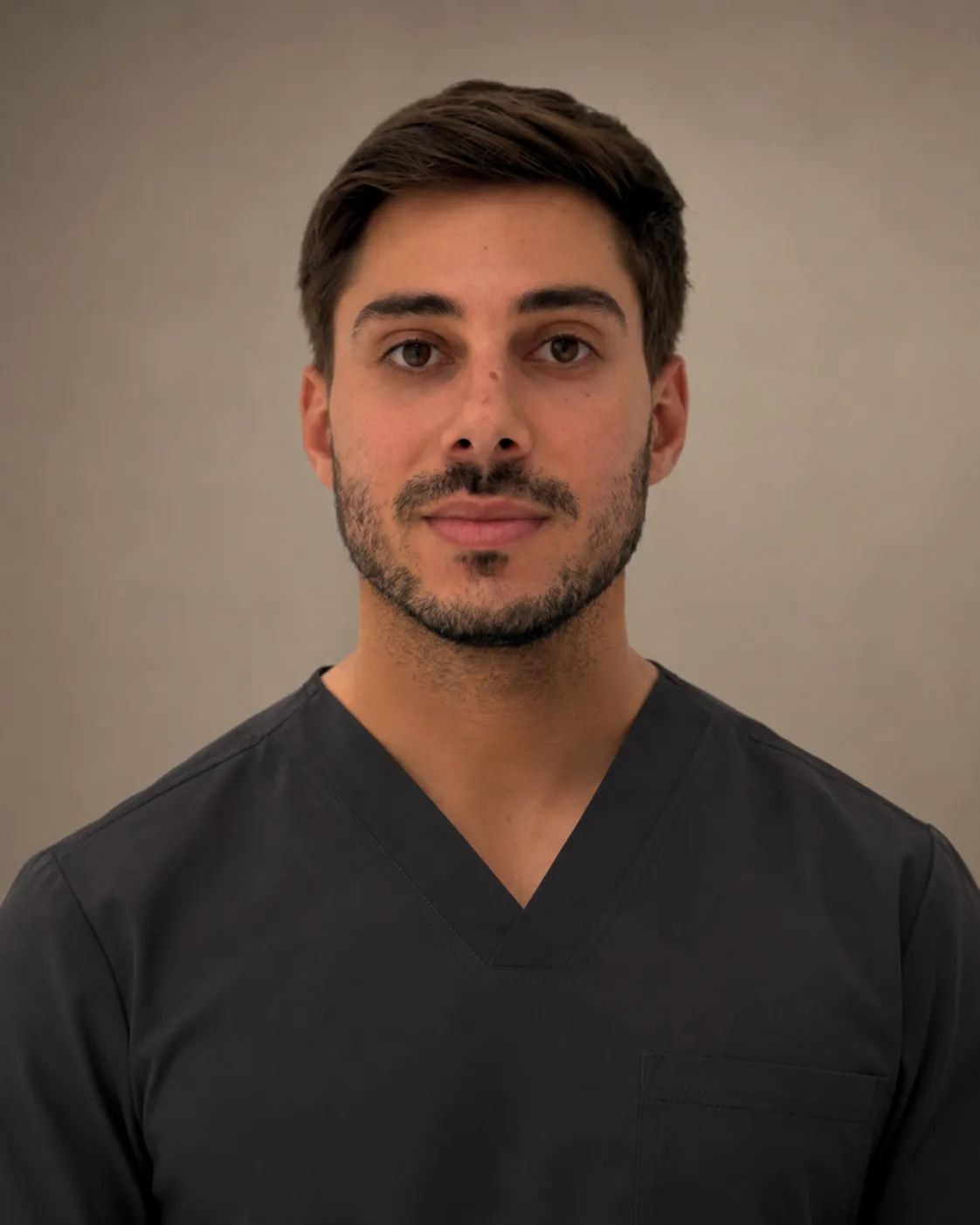
 Medical content reviewed by Dr. Enrico Giorgio Morales Tedone Dermatologist · Medical registration no. 461205707 · Last reviewed 8 August 2026
Hair loss is one of the most common reasons for consultation and also one of the most confusing, as very different problems can cause the same symptoms. At the trichology unit of dermaMER Instituto Médico Dermatológico, in Valencia, we always start with one principle: before treating «hair loss», we must diagnose its cause. Temporary shedding differs from androgenetic alopecia, alopecia areata and scarring alopecia, and each needs a different approach.
What is normal and what is not
Each hair follows a cycle: a growth phase lasting years, a short transition phase and a resting phase lasting a few months, after which it sheds to make way for a new hair. Daily shedding is therefore normal: between 30 and 150 hairs a day is considered normal, varying with washing, styling and hair length. Counting shower hairs alone cannot diagnose anything.
Two concepts should be distinguished: increased shedding (effluvium) means more hairs are falling out than normal, whereas alopecia is an actual loss of density or the appearance of hairless areas. They may occur separately or together: heavy shedding can occur without permanent alopecia, and alopecia can progress without noticeable daily shedding.
The hair cycle
A growth phase lasting years, a short transition and a resting phase of a few months before shedding.
Increased shedding (effluvium)
More hairs fall out than normal; heavy shedding can occur without permanent alopecia.
Alopecia
Actual loss of density or hairless areas; it may progress without noticeable daily shedding.
Diagnosing the cause
Medical history and digital trichoscopy before treatment: there is no general product for «hair loss».
Types and causes: when it is temporary and when to investigate
Telogen effluvium
Diffuse, reactive shedding that usually starts two to four months after various triggers. It usually resolves once the trigger has been identified and corrected, which requires prior diagnosis; in some cases, we consider supportive treatment.
Androgenetic alopecia
The most common type, with a genetic and hormonal basis. Rather than shedding, there is progressive hair thinning at the temples, crown or central parting. Early diagnosis by your dermatologist is very important to prevent progression with permanent hair loss. Treatment of androgenetic alopecia aims to slow progression and, in many cases, improve the thickness of existing hair.
Alopecia areata
An autoimmune condition causing round, smooth patches. It is non-scarring and hair can regrow with appropriate treatment at the clinic. You can read in detail about our approach to alopecia areata.
Scarring alopecias
Such as frontal fibrosing alopecia. Inflammation destroys the follicle and replaces it with scar tissue. Hair in scarred areas does not regrow, so early diagnosis is crucial and treatment aims to stop the process.
When to seek advice
- Shedding lasts more than six months or returns in episodes.
- The parting, temples or crown gradually thin.
- Hairless patches appear, or eyebrows or eyelashes are lost.
- There is intense itching, pain, marked scaling or pustules.
- Shedding starts after a new medication or has not recovered a year after childbirth.
How we diagnose it
Diagnosis begins with a focused medical history — onset, progression, illnesses, diets, medication, family history and scalp symptoms — and careful examination.
We use digital trichoscopy, which magnifies scalp structures and helps distinguish the miniaturisation of androgenetic alopecia, signs of alopecia areata and the loss of follicular openings in scarring alopecias. This examination turns a clinical impression into a diagnosis and individualised treatment, and allows comparison at reviews for appropriate clinical follow-up.
Hair loss treatment: it depends on the cause
There is no single treatment for «hair loss».
For telogen effluvium , the main step is to correct the trigger where possible and support recovery with oral or in-clinic treatment when indicated.
Conditions such as androgenetic alopecia, alopecia areata and scarring alopecias have specific treatments, explained on their pages. These may include prescription topical treatment, oral medication or systemic treatment depending on the diagnosis and disease stage. The specific regimen is decided during consultation once the cause is identified.
Supportive in-clinic procedures
In selected cases, as an adjunct to medical treatment, we consider procedures performed at the clinic such as scalp mesotherapy or scalp PRP. These procedures are not usually covered by insurance policies and are paid for separately; we provide a quote at the assessment consultation before starting anything.
What treatment cannot achieve
There is no universal solution or immediate recovery: the hair cycle is measured in months, not weeks, and no treatment should be judged from photographs taken only days apart. A follicle destroyed by scarring cannot regenerate. Pharmacy supplements have no general benefit without a documented deficiency, and shampoo addresses hygiene or scalp dermatitis, rather than hormonal, autoimmune or scarring alopecia.
The important thing is to avoid «trying» products without a diagnosis: this can mean months of unhelpful treatments and delay care for conditions needing prompt action.
Your first hair loss consultation at dermaMER
The first visit aims to classify the problem: temporary shedding, miniaturisation, patches or scarring alopecia.
It is very helpful to bring earlier photographs with comparable lighting and hairstyle, a complete list of medication and supplements, and information about illnesses, childbirth or weight changes in preceding months. We examine the entire scalp, assess density and hair thickness, perform digital trichoscopy and, depending on the case, request targeted blood tests.
Consultation and follow-up are usually covered by health insurance policies, subject to each insurer’s conditions and policy type. Supportive procedures are usually excluded and paid for separately. We confirm this when you book.
Hair loss care is part of our hair medicine service in Valencia, available in Spanish, English and Italian. You can meet the medical team before your visit.
Frequently asked questions about hair loss
How many hairs is it normal to lose each day?
Losing between 30 and 150 hairs a day is considered physiological, varying with washing, styling and hair length. Counting shower hairs alone cannot diagnose anything.
When does it stop being normal?
When heavy shedding continues for more than two or three months without easing, lasts more than six months, the parting or temples gradually thin, or patches, eyebrow loss, itching, pain or scaling develop.
What results can I expect from treatment?
This depends entirely on the cause. Effluvium usually recovers once the trigger is corrected, although volume takes months to return. In androgenetic alopecia, the aim is to slow progression rather than restore teenage density, although many cases also show improved hair thickness.
What about anti-hair-loss shampoos?
Shampoo addresses hygiene or scalp dermatitis, but does not reverse hormonal, autoimmune or scarring alopecia. It may support treatment, but cannot replace it.
Do scalp mesotherapy or PRP help every type of hair loss?
No. They are supportive procedures that complement medical treatment in selected cases, and suitability depends on the diagnosis: they are not indicated for every alopecia and do not replace treatment of the cause.
Does hair loss after childbirth recover?
Usually, yes: postpartum hair loss is telogen effluvium and generally resolves, although volume takes months to recover.
Does health insurance cover a hair loss consultation?
Usually, yes: consultation and follow-up are generally included in health insurance policies, subject to the insurer’s conditions and policy type. Supportive procedures are usually excluded and paid for separately. Check the insurers we work with.
Trichology consultation for hair loss in Valencia
dermaMER Instituto Médico Dermatológico
Calle Timoneda 4, Bajo, 46008 Valencia
Mon–Wed 9:00–14:00 and 15:00–19:00 · Thu 10:00–14:00 and 15:00–19:00 · Fri 9:00–14:00
☏ +34 960 20 71 71
View on Google Maps