
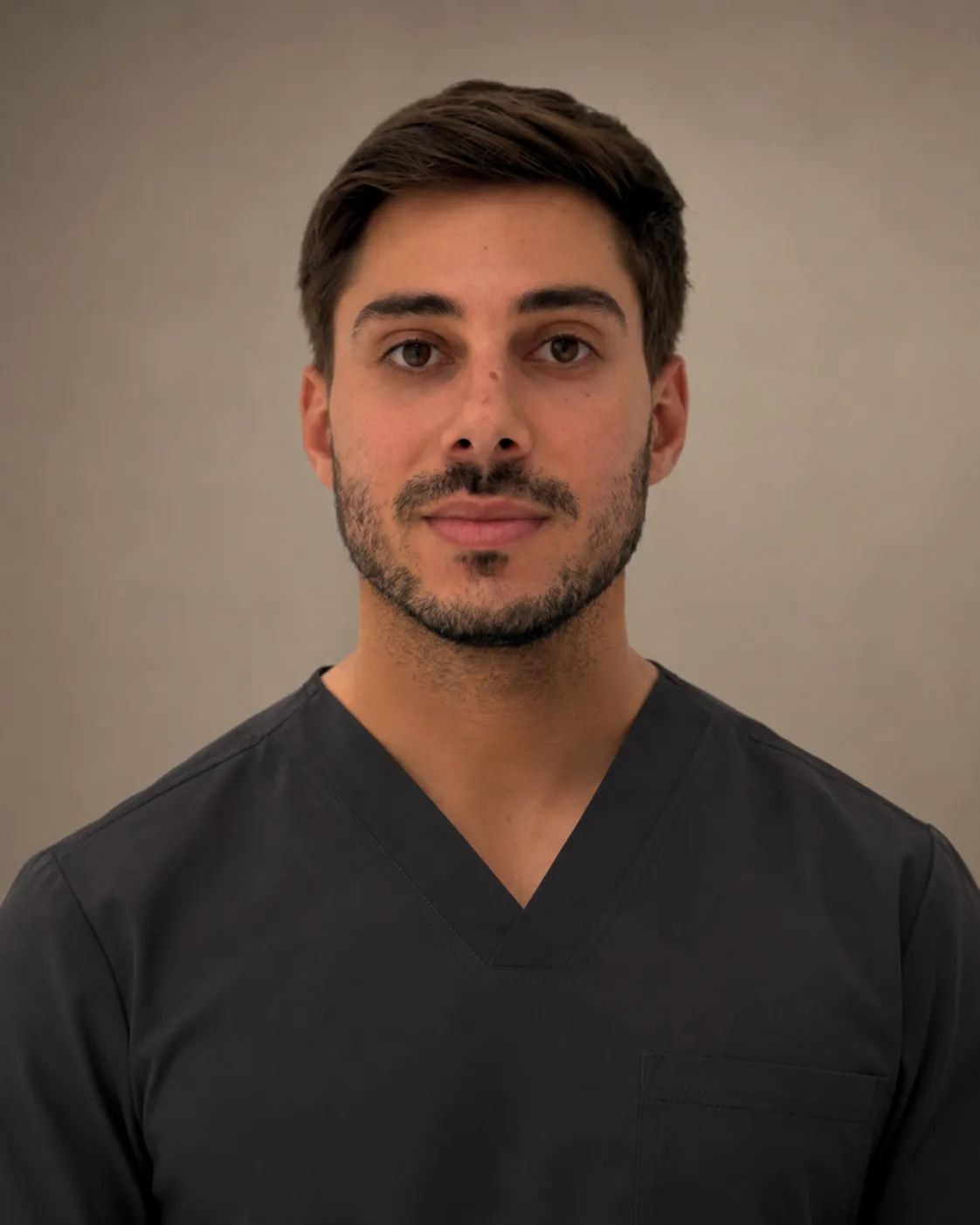
 Medical content reviewed by Dr. Enrico Giorgio Morales Tedone Dermatologist · Medical registration no. 461205707 · Last reviewed 8 August 2026
Acne is an inflammatory skin condition that can develop during adolescence or adulthood. It causes blackheads, whiteheads, inflamed spots, deep lesions, pigmentation and scars.
At dermaMER Instituto Médico Dermatológico, we diagnose and treat acne in Valencia. At each consultation, we assess the type of lesions, their severity, the areas affected, previous treatments and any pigmentation or scars.
The aim is twofold: to control active disease and reduce the risk of scarring, or treat existing scars.
What is acne and why does it develop?
Acne develops when skin follicles become blocked with oil and dead skin cells. Excess sebum, hormonal factors, blocked pores, the growth of certain skin bacteria and inflammation all play a part.
Healthy follicle
The hair and sebaceous gland function normally.
Blocked pore
Oil and dead skin cells block the pore, forming a comedone.
Bacteria
Certain skin bacteria multiply in the trapped sebum.
Inflammation
The body responds: inflamed spots and, sometimes, deep lesions.
Genetic predisposition, some cosmetics, certain medical treatments and stress also play a role.
Acne is not caused by poor hygiene. Excessive cleansing or scrubbing can irritate the skin and worsen lesions.
Diet is not the only cause. In some patients, certain eating patterns coincide with more frequent flare-ups. There is no universal acne diet.
What types and grades of acne are there?
Not all patients have the same lesions. Identifying the type of acne helps us select suitable treatment.
Comedonal acne
Blackheads and whiteheads predominate, with little inflammation. This is usually a mild or early form.
Inflammatory acne
Red, tender or pus-filled spots develop. It may affect the face, chest, shoulders and back.
Nodular or cystic acne
This causes deep, painful, persistent lesions. It carries a high risk of scarring and requires dermatological assessment.
Adult female acne
This usually affects the chin, jawline and lower face. In some cases, there is a hormonal influence that should be assessed during the consultation.
Severity depends on more than the number of spots. Their depth, extent, duration, risk of scarring and emotional impact are also assessed.
What is the difference between acne marks and scars?
Marks and scars are different.
Red or brown marks that remain after a flare-up are colour changes caused by inflammation. They may gradually fade, although in some patients they persist for months.
Acne scars are a permanent change in the skin’s structure. They may appear as depressions or raised areas.
The best approach to scarring is to reduce the risk of it developing by controlling active acne early. For existing scars, we have techniques that may improve their appearance and texture.
Red marks and dark spots
Red marks are more common in fair skin. Brown marks, known as post-inflammatory hyperpigmentation, develop more readily in medium to dark skin phototypes.
There is no single treatment for all marks. The choice depends on their colour, depth, the skin phototype and how long they have been present.
Atrophic scars
These are depressions or indentations in the skin’s surface. They are classified by shape:
- Ice pick: narrow and deep.
- Boxcar: wider, with defined edges.
- Rolling: broad, shallow and wave-like.
Raised scars
These are thickened scars that project above the skin’s surface. They occur more frequently on the chest, shoulders, back and jawline.
Correctly identifying the scar type is essential, as each form requires a different approach.
How do we treat acne at dermaMER Valencia?
There is no single treatment for every patient. The plan depends on the type of acne, its severity, age, skin tolerance, previous treatments and risk of scarring.
Treatments applied to the skin
Topical active ingredients used in dermatology are prescribed in an individualised medical regimen to reduce pore blockage, control inflammation and reduce new lesions.
They require consistency. During the first few weeks, they may cause dryness, flaking or irritation. Your dermatologist explains how to introduce them and adapt your cleansing, moisturising and sun protection routine.
Oral treatments
Oral medication is reserved for cases that warrant it: moderate, severe or persistent acne, or acne at risk of scarring.
The choice depends on the type of acne, age, medical history and each patient’s circumstances. Prescription and follow-up always take place under dermatological supervision, with the monitoring required by the product information: periodic blood tests where appropriate and, for women of childbearing age, the contraceptive measures required because of the teratogenic risk of certain treatments.
Additional dermatological procedures
In selected cases, medical procedures may be used to improve inflammation, marks or skin texture.
These procedures do not replace treatment for active acne. They form part of a comprehensive dermatological plan.
How are acne marks and scars treated?
It is advisable to control active flare-ups before treating scars. If inflammatory lesions continue to develop, new marks may also form.
Treatment is selected according to scar type, depth, extent, skin phototype and the time available for recovery.
Treatment of red and brown marks
Marks may be addressed with sun protection, home treatments prescribed by your dermatologist, medical peels and certain light or laser systems.
Treatment varies depending on whether redness, dark pigmentation or a combination of both predominates.
Microneedling
The microneedling procedure creates controlled microperforations to stimulate skin remodelling.
It is mainly indicated for certain superficial atrophic scars. Several sessions are normally required.
Fractional laser
The fractional CO₂ laser acts on tiny columns of skin to stimulate renewal and improve texture.
It is used for atrophic scars and skin surface irregularities. Suitability depends on the scar type, skin phototype and risk of subsequent pigmentation.
Medical peels
Medical peels produce controlled renewal of the superficial skin layers.
They are mainly used to treat pigmentation, uneven texture and certain types of superficial scars.
Combined treatments
Acne scars are rarely uniform. Deep, superficial and tethered scars and residual pigmentation may coexist in the same person.
For this reason, the most suitable treatment may combine different techniques across several sessions.
Complete disappearance of all scars cannot be promised. Treatments may improve their appearance and texture, with results varying according to scar type and individual skin response, but they do not restore the skin to its original state. Be wary of any proposal promising to eliminate acne or erase scars completely in one session. Our commitment is to set realistic goals and clearly explain what you can expect in your case.
How long does acne take to improve?
Acne treatment does not produce immediate results. Improvement is assessed gradually over the weeks after starting the plan.
The time needed depends on severity, lesion depth, treatment consistency and individual skin response.
During follow-up, the regimen may need adjusting, a product replacing or several treatments combining.
Stopping the plan too early limits its benefits. Once the flare-up is controlled, some patients need maintenance treatment to reduce relapses.
When should you see a dermatologist for acne?
Many people live with acne for years, waiting to «grow out of it». It is worth seeking advice earlier than you might think, especially:
- If deep or painful lesions develop, with nodules or cysts.
- If acne leaves pigmentation or scars.
- If it affects the chest or back.
- If it does not improve after several weeks of over-the-counter pharmacy products.
- If it persists or returns in adulthood.
- If its onset has been sudden or particularly severe.
- If there are signs of a possible hormonal disorder.
- If it affects your mood, self-esteem or daily life.
- If you are planning a pregnancy or are pregnant.
- If oral treatment is being considered.
The psychological impact of acne is real and well documented, and is a valid reason to treat it. Seeking advice early does more than shorten the time your skin is affected: it reduces the risk of permanent scars, which are harder to correct than prevent.
What happens at your first acne consultation at dermaMER?
During your first consultation, we review how your acne has developed, treatments used, cosmetic products, medical history and factors that coincide with flare-ups.
We then examine your skin to identify:
- the type of acne;
- the degree of inflammation;
- the areas affected;
- any pigmentation;
- the type of scars;
- the risk of new marks.
We use this information to develop a personalised plan. We also explain how to use each treatment, care for your skin at home, what results to expect and when to attend your next review.
At dermaMER, we see adolescents and adults with acne at our medical dermatology clinic in Valencia. You can meet our dermatologists before your visit.
Frequently asked questions about acne
Is acne caused by dirty skin?
No. Acne is not caused by poor hygiene. Aggressive cleansing increases irritation.
Should I squeeze spots?
No. Picking or squeezing spots increases inflammation and the risk of pigmentation and scars.
Does adult acne always have a hormonal cause?
No. Hormones play a role in some patients but not others. The distribution of lesions, associated symptoms and medical history guide the assessment.
Do scars disappear completely?
Their complete disappearance cannot be promised. Treatments aim to make them shallower, soften their edges and improve texture.
How many sessions are needed to treat scars?
There is no fixed number. It depends on the scar type, depth, technique selected and skin response.
Can scars be treated if I still have acne?
The level of activity must be assessed first. In general, controlling flare-ups takes priority to prevent new scars developing during treatment.
At what age should acne treatment start?
There is no minimum age: treatment starts when acne develops. Treatment may already be appropriate in early adolescence, and waiting to «grow out of it» is precisely what increases the risk of permanent scars. At the other end of the spectrum, adult female acne may first appear after the age of 25 and also has specific treatments.
Can I wear make-up if I have acne or am undergoing treatment?
Yes. Make-up does not worsen acne if you choose non-comedogenic products and remove it properly at the end of the day. Some treatments make the skin more sensitive or dry, so both make-up and your cleansing and moisturising routine may need adjusting. We explain this during your consultation according to your treatment regimen.
Does my health insurance cover acne treatment?
Dermatology consultations and acne diagnosis are usually covered by health insurance policies, although conditions vary by insurer and policy type. Aesthetic procedures and scar treatments — medical peels, microneedling or laser — are usually outside cover and paid for separately. Check the insurers we work with or ask us before your appointment.
Can acne be treated in summer or with sun exposure?
Yes, although some treatments increase the skin’s sensitivity to sunlight and require strict sun protection and adjustments to the regimen. It is a myth that sunlight improves acne: it may temporarily dry lesions, but worsening often follows, and it also encourages residual pigmentation to darken and persist longer.
Dermatology consultation for acne in Valencia
dermaMER Instituto Médico Dermatológico
Calle Timoneda 4, Bajo, 46008 Valencia
Mon–Wed 9:00–14:00 and 15:00–19:00 · Thu 10:00–14:00 and 15:00–19:00 · Fri 9:00–14:00
☏ +34 960 20 71 71
View on Google Maps