
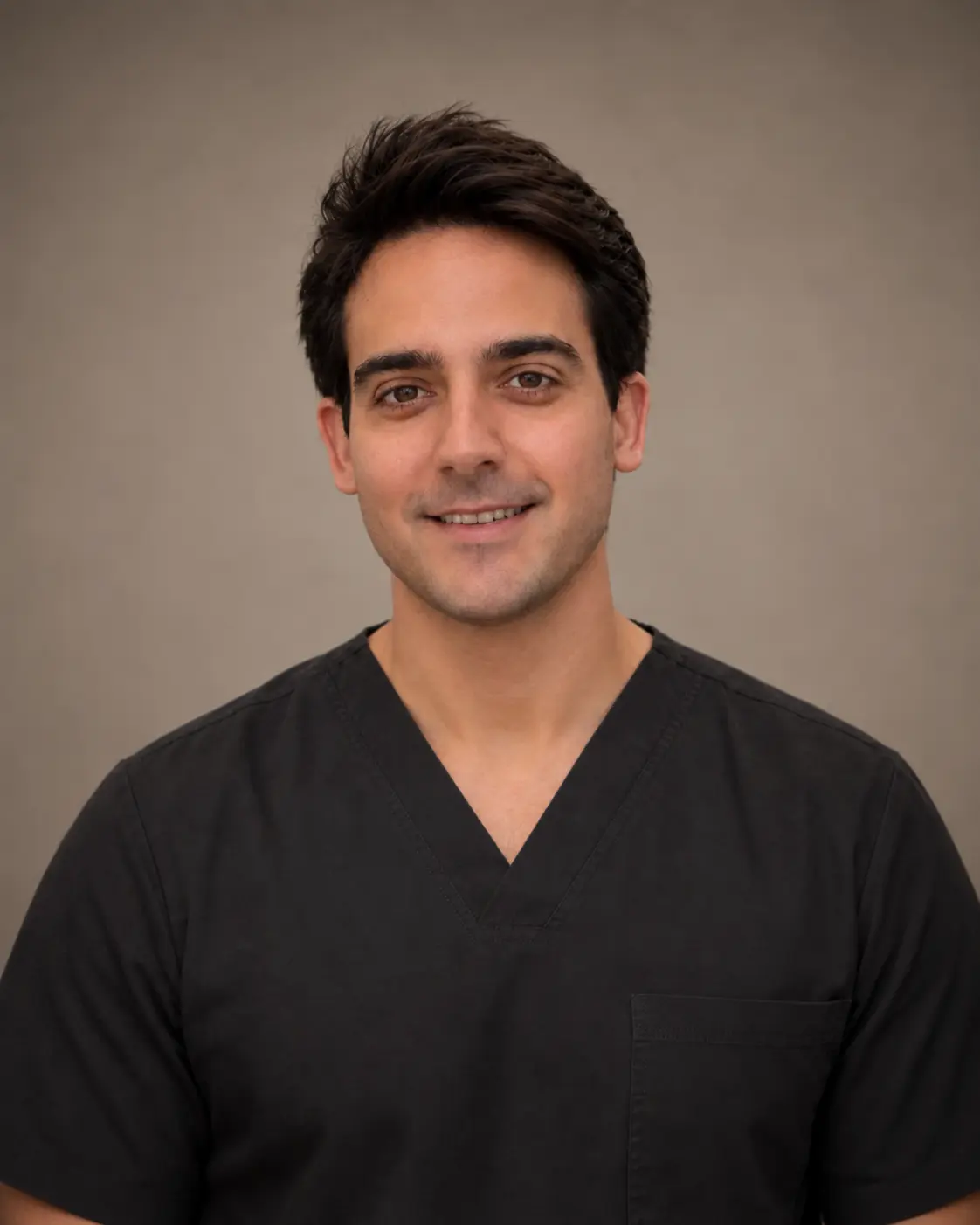
 Medical content reviewed by Dr. Román Ballesteros Redondo Dermatologist · Medical registration no. 462009018 · Last reviewed 8 August 2026
Platelet-rich plasma (PRP) is a supportive treatment for hair loss using a preparation obtained from your own blood. It is mainly used for chronic effluvium and, to a lesser extent, androgenetic alopecia, as an adjunct to medical treatment. At the trichology unit of dermaMER Instituto Médico Dermatológico, in Valencia, we offer it with dermatological judgement and honesty about the evidence: it may increase density in some patients and slow accelerated shedding, but is always preceded by proper diagnosis to establish suitability.
What scalp PRP is and when it is considered
PRP is an autologous preparation: it comes from your own blood, rather than a donor. Blood is drawn and centrifuged, and the plasma fraction with a higher-than-normal platelet concentration is selected and injected into the scalp. Platelets release growth factors involved in tissue repair, with proposed effects on the follicle.
There is no «single PRP»: the name covers preparations with different platelet and white blood cell concentrations, with or without activation. These differences explain some variation between studies, and more platelets do not mean a better response.
The indications with the most studies are chronic effluvium and androgenetic alopecia in early or moderate stages, while viable miniaturised follicles remain: the expected response is a partial increase in density or reduced shedding. It is an adjunct to medication with stronger evidence, rather than a standalone first-line treatment. It is not injected without prior diagnosis.
Prior diagnosis
No injections without diagnosis: digital trichoscopy confirms viable follicles.
Blood collection and centrifugation
Blood is drawn and centrifuged, and the platelet-rich plasma fraction selected.
Injection
The platelet-rich fraction is injected into the scalp, with the materials used recorded.
Regimen and assessment
Several induction sessions followed by spaced maintenance; assessment at three to six months using photographs and digital trichoscopy.
How it differs from scalp mesotherapy
Both involve scalp injections, but they are different. Scalp mesotherapy injects an identifiable, traceable external substance in scheduled sessions; PRP uses a freshly prepared product from your own blood. The appropriate choice depends on diagnosis and is decided during consultation.
What a session involves and how many are planned
The session involves blood collection, centrifugation, preparation of the fraction and injection into the scalp, with a record of materials used. It lasts about 10-15 minutes, requires no rest and allows you to return to your activities the same day.
Injections cause pain or pressure, managed with cooling or local anaesthetic.
There is no validated international standard regimen. The usual approach is an induction course of several sessions — often three, monthly — followed by maintenance every three to six months.
Results are assessed at three to six months using standardised photographs and digital trichoscopy.
Results, evidence and limitations
The best-supported outcomes are reduced shedding in chronic telogen effluvium and increased hair density in androgenetic alopecia. For the latter, following proper diagnosis, mesotherapy with active ingredients supported by stronger evidence is the preferred option. Some patients report a cosmetic improvement in their hair.
There is no universal proportion of patients who respond, and a measurable density increase does not always mean an obvious cosmetic change: perception depends on baseline density, colour and contrast.
What it can and cannot achieve
It may support medical treatment in carefully selected patients, with objective review criteria.
It does not cure androgenetic alopecia, which is chronic, or act on the main disease pathway as oral medication or scalp mesotherapy with scientifically supported active ingredients do, and it does not replace established treatments. It is used as an adjunct to improve the overall result.
Risks, contraindications and regulation
As a preparation from your own blood, PRP has a good tolerance profile. Pain during injections, tenderness and some bruising are common.
It should be carefully assessed or avoided with very low platelets or clotting disorders, active infection, significant anaemia or haematological disease; elective treatments are postponed during pregnancy.
In Spain, PRP is regulated as a substance of human origin. It is performed in an authorised centre using aseptic technique, traceability and record-keeping.
Your first scalp PRP consultation at dermaMER
We establish the diagnosis first: PRP is not recommended simply because hair is shedding. We take your history, examine with digital trichoscopy to confirm viable follicles and take baseline photographs.
Before proposing anything, we explain:
- that results take months and vary;
- the preparation type, number of sessions and intervals;
- the cumulative cost and criteria for stopping if there is no response.
It is part of our hair medicine service in Valencia, and you can meet the medical team before your visit.
It is not usually covered by insurance policies and is paid for separately. A registered dermatologist recommends and performs it, and we provide a quote at the assessment consultation before any treatment. You can check our indicative prices on the Fees page.
Frequently asked questions about scalp PRP
What results can I expect?
Reduced shedding in chronic effluvium and increased hair density in androgenetic alopecia. A consistent increase in individual hair thickness has not been demonstrated, and there is no universal proportion of patients who respond. It is used alongside topical or oral medication and medicated scalp mesotherapy.
Does it hurt?
Injections cause pain or pressure, managed with cooling or topical anaesthetic. Blood is drawn beforehand, as for a blood test.
How many sessions are needed?
There is no validated standard regimen. The usual approach is an induction course of several sessions, often three monthly sessions, followed by maintenance every few months.
How long does the effect last?
Maintenance is needed: a single course does not produce permanent results. As androgenetic alopecia is chronic, the underlying process continues after stopping. Chronic conditions require ongoing treatment, whether topical, oral or in-clinic.
Can it replace medical treatment?
No. It does not act on the main disease pathway or replace established treatments: it is offered as an adjunct, and never without prior diagnosis confirming viable follicles.
When can I return to normal activities?
Immediately. Your scalp may remain tender for a few hours, and strenuous exercise should be avoided that day.
Does health insurance cover it?
No. It is generally a separately paid complementary procedure, with a quote at the assessment consultation. The dermatological assessment of hair loss, however, is usually covered, subject to each insurer’s conditions; check the insurers we work with.
Trichology consultation for scalp PRP in Valencia
dermaMER Instituto Médico Dermatológico
Calle Timoneda 4, Bajo, 46008 Valencia
Mon–Wed 9:00–14:00 and 15:00–19:00 · Thu 10:00–14:00 and 15:00–19:00 · Fri 9:00–14:00
☏ +34 960 20 71 71
View on Google Maps