
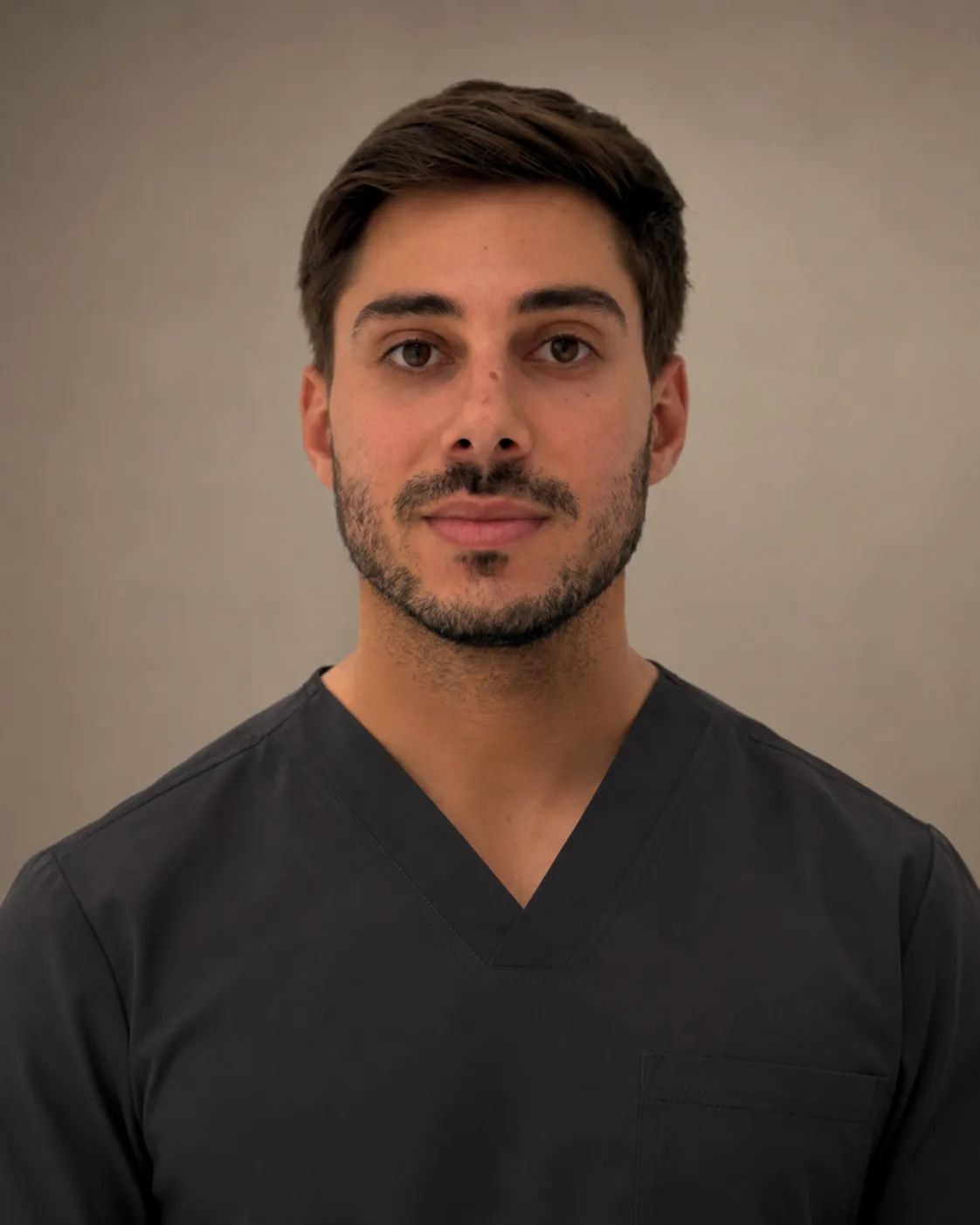
 Medical content reviewed by Dr. Enrico Giorgio Morales Tedone Dermatologist · Medical registration no. 461205707 · Last reviewed 8 August 2026
Acne scars and certain benign skin lesions are two of the main indications for CO₂ laser at dermaMER.
For moderate and severe acne scars, fractional CO₂ laser works on skin structure and stimulates gradual collagen remodelling. For mild or moderate scars where faster recovery is desired, we also offer non-ablative fractional laser, which works without vaporising the skin surface.
CO₂ laser also treats many previously diagnosed benign lesions with great precision and, in selected cases, a less noticeable scar than conventional surgical excision. The choice between laser, surgery or another technique always depends on lesion type, location and whether analysis is needed.
What CO₂ laser and non-ablative fractional laser are
CO₂ laser is ablative: it produces controlled skin vaporisation, followed by repair and new collagen formation.
In fractional mode, it acts on multiple microscopic columns, leaving intact skin between them. This allows intensive scar and texture treatment without treating the entire surface uniformly.
At dermaMER, we also offer non-ablative fractional laser. This produces columns of heat deeper in the skin without vaporising the surface. Recovery is faster, although its remodelling capacity is more limited than CO₂ for deep scars.
The difference between ablative and non-ablative laser is whether the skin surface is vaporised. This determines treatment intensity, recovery and the scar types for which each is indicated.
We do not always seek the most intensive treatment. We choose technology according to scar type, depth, skin phototype and the recovery time each patient can accommodate.
Controlled vaporisation
CO₂ laser is ablative: it vaporises the skin surface and triggers subsequent repair.
Fractional mode
It acts on multiple microscopic columns, leaving intact skin between them.
Non-ablative fractional laser
It produces deeper heat columns without vaporising the surface: faster recovery, more limited remodelling.
Choosing according to the scar
Technology is selected according to scar type, depth, phototype and the recovery each patient can accommodate.
Acne scars: choosing laser according to depth
Acne scars vary. Some cause superficial irregularities; others create deep depressions or tethered skin. There is therefore no single treatment suitable for everyone. You can also see our dermatological approach to acne and acne scars .
Mild and moderate scars: non-ablative fractional laser
When mild or moderate scars, texture changes and enlarged pores predominate, non-ablative fractional laser stimulates collagen remodelling without removing the skin surface.
Its main advantage is faster recovery. Change is gradual and several sessions are usually planned. For very superficial scars and texture, microneedling offers an even less intensive alternative.
Moderate and severe scars: fractional CO₂ laser
For deeper scars or more marked structural changes, fractional CO₂ laser allows more intensive treatment.
The aim is to reduce scar depth and contrast and create a more even surface, rather than erase the scar. Remodelling continues over subsequent months.
Deep or tethered scars may require combined techniques. The initial assessment determines which scars respond to laser and which need a different or combined approach.
Benign lesion removal with CO₂ laser
CO₂ laser is also particularly useful for certain benign skin lesions, such as seborrhoeic keratoses, warts and other previously diagnosed raised lesions.
It allows very precise tissue vaporisation and control of treatment depth. In appropriately selected lesions, this may produce a less noticeable scar than conventional surgical excision, especially where surgery would require an incision and stitches.
This does not mean laser is always preferable to surgery. Some lesions must be excised for microscopic analysis; others are better treated surgically because of size, depth or location.
Prior diagnosis is therefore essential. We never vaporise a mole, pigmented patch or any uncertain lesion simply to remove it. Destroying it would prevent analysis and could delay skin cancer diagnosis.
During consultation, we explain whether your lesion can be treated with CO₂ laser or whether conventional excision or another technique is preferable.
Treatment, results and recovery
Before the procedure, we confirm diagnosis and assess lesion or scar type, skin phototype, recent tanning and history that may affect treatment.
For acne scars, session numbers depend on depth and technology. Non-ablative fractional laser is usually planned as gradual treatment over several sessions. Fractional CO₂ is more intensive and requires more recovery between sessions.
Most benign lesions can be treated in one session.
After fractional CO₂, redness, swelling and small crusts are expected for several days. Non-ablative fractional laser generally involves shorter, less visible recovery.
Scar results should not be judged immediately. Collagen remodelling continues over subsequent months.
What laser cannot do
No laser completely removes an acne scar. The aim is to reduce depth, contrast and irregularity.
Scars do not all respond equally, and laser alone is not suitable for every scar. Combined procedures are sometimes needed.
For benign lesions, less scarring than surgery cannot be promised in every case. It depends on lesion type, depth, location, size and individual healing.
Risks, skin phototypes and contraindications
CO₂ is ablative and requires real recovery time. Redness, swelling, burning, oozing and crusting are expected to varying degrees according to treatment.
Possible complications include pigment changes, infection, herpes reactivation and scarring. Pigmentation risk is higher in certain phototypes, tanned skin and people with melasma.
Treatment should be postponed or reconsidered with active infection or herpes, severe inflammatory acne, wounds, recent tanning, certain healing problems, immunosuppression, pregnancy or an uncertain lesion diagnosis.
Non-ablative fractional laser has less surface recovery, but is not risk-free and also requires appropriate medical selection.
Your first laser consultation at dermaMER
The first decision is which treatment suits your concern, rather than what laser intensity to use.
For acne scars, we assess type, depth and distribution. We may then suggest non-ablative fractional laser for mild or moderate scars, fractional CO₂ for moderate or severe scars, or combined techniques when needed.
For lesion removal, we first confirm it is benign and assess whether laser offers an advantage over conventional surgery. If the lesion must be preserved for analysis, we do not vaporise it.
Before the procedure, we explain reasonable results, indicative session numbers, recovery and aftercare.
It is part of our aesthetic medicine and laser service in Valencia. Cosmetic treatments are not usually covered by health insurance policies and are paid for separately. A registered dermatologist recommends and performs treatment, and you receive a quote during assessment. You can check our indicative prices on the Fees page.
You can meet the medical team before your visit.
Frequently asked questions about CO₂ laser and acne scars
Does CO₂ laser completely remove acne scars?
No. The aim is to reduce depth and contrast and improve skin evenness. Deep scars may require several combined techniques.
How many sessions are needed?
This depends on scar type, depth and the laser used. Non-ablative fractional laser usually involves several sessions; CO₂ treatment is more intensive, with longer intervals.
How much recovery time do I need?
This depends on technology and intensity. Non-ablative fractional laser has faster recovery. Fractional CO₂ causes redness and small crusts for several days, and redness may persist longer.
Can I have a wart or keratosis removed with CO₂ laser?
Yes, when a dermatologist has first confirmed a benign lesion suitable for treatment. In selected cases, it allows very precise removal with a less noticeable scar than conventional surgical excision.
Can it remove a mole?
No. A pigmented lesion must not be vaporised without prior diagnosis. If there is any diagnostic doubt, tissue must be preserved for examination and laser is unsuitable. Your dermatologist will advise you in every case.
Can I have treatment in summer or with tanned skin?
We do not perform ablative treatment on tanned skin because pigment-change risk increases. The season and planned sun exposure are assessed individually.
Does it hurt?
Yes. It is uncomfortable, so we do not perform it without anaesthetic. We use anaesthetic cream and, where required, injected anaesthetic to make the session manageable. A burning sensation for a few hours afterwards is expected.
How long do results last?
Treatment produces collagen remodelling, so treated tissue does not return to its starting point and improvement persists over time. Ageing and sun exposure continue affecting the skin.
Does health insurance cover it?
No. Cosmetic treatments are not usually covered by health insurance policies and are paid for separately. We provide a quote during assessment. If your question concerns another dermatology consultation, you can check the insurers we work with.
Dermatology consultation for CO₂ laser in Valencia
dermaMER Instituto Médico Dermatológico
Calle Timoneda 4, Bajo, 46008 Valencia
Mon–Wed 9:00–14:00 and 15:00–19:00 · Thu 10:00–14:00 and 15:00–19:00 · Fri 9:00–14:00
☏ +34 960 20 71 71
View on Google Maps