
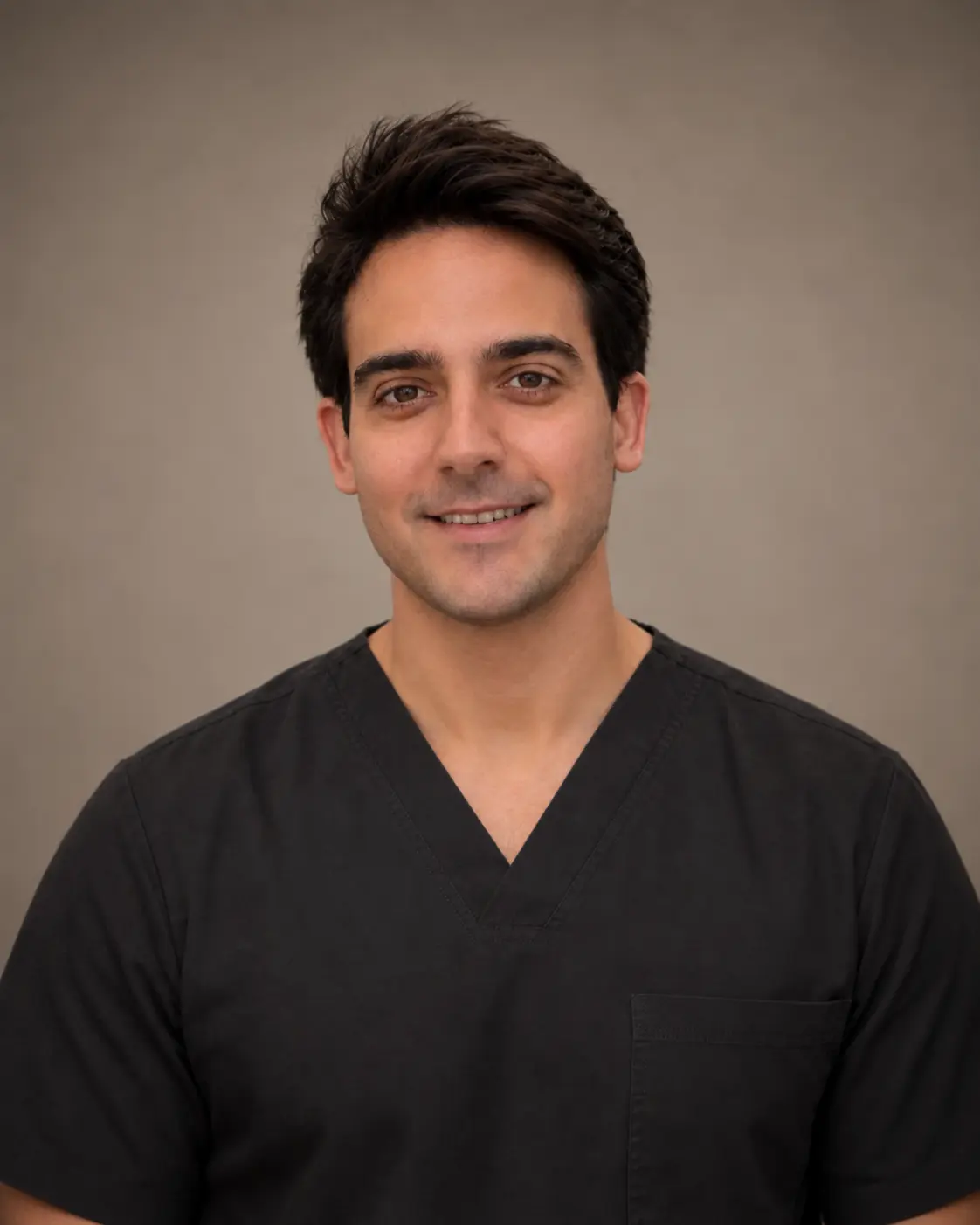
 Medical content reviewed by Dr. Román Ballesteros Redondo Dermatologist · Medical registration no. 462009018 · Last reviewed 8 August 2026
Frontal fibrosing alopecia is a scarring alopecia: inflammation destroys follicles and replaces them with scar tissue, so lost hair cannot regrow. Early diagnosis is therefore crucial. At the trichology unit of dermaMER Instituto Médico Dermatológico, in Valencia, early detection and treatment pursue an honest goal: slowing progression and preserving viable hair rather than restoring scarred areas.
What frontal fibrosing alopecia is
This is an inflammatory scarring alopecia in which the immune system damages the follicular stem-cell area. Distribution is characteristic: progressive, generally symmetrical recession of the frontal hairline and temples, with loss of follicular openings in scarred areas. Eyebrow loss is very common and sometimes precedes hairline recession. Itching, burning or tightness may occur, although many people have no discomfort.
It mainly affects postmenopausal women, but increasingly also premenopausal women and men. Other hair conditions frequently coexist, such as androgenetic alopecia, requiring separate assessment of each component.
Follicular inflammation
The immune system damages the follicular stem-cell area.
Scar replacing the follicle
Inflammation destroys the follicle and replaces it with scar tissue: that hair cannot regrow.
Frontal hairline recession
Progressive, symmetrical frontal and temple recession, often with eyebrow loss.
Slowing progression
Treatment acts on remaining follicles and inflammation at the edge, rather than scarred areas.
Why early diagnosis changes prognosis
Treatment acts on remaining follicles and inflammation ahead of the scarred edge, rather than smooth areas: destruction before treatment is irreversible. Progression speed varies, so early objective assessment matters. Where eyebrows still retain follicles, injections may help preserve them, with variable results and a greater chance of response with earlier action.
Seek advice promptly for:
- frontal or temple recession, especially with a band of smooth or lighter skin;
- thinning or loss of one or both eyebrows without an obvious cause;
- loss of sideburns;
- isolated hairs ahead of a receding hairline;
- persistent redness, scaling, itching or burning at the frontal edge.
How we diagnose it
Diagnosis relies on recession pattern, eyebrow loss, scarred skin appearance and digital trichoscopy, showing absent follicular openings in scarred areas and redness and scaling around hairs at the active edge. For follow-up, we suggest standardised photographs and hairline measurements: daily mirror checks cannot distinguish a few millimetres of progression.
Frontal fibrosing alopecia treatment in Valencia
There is no cure or single protocol: the aim is to suppress inflammation and stabilise disease. Depending on the case, the plan combines gentle scalp care without traction, prescription anti-inflammatory topical treatment, anti-inflammatory injections through mesotherapy at the frontal edge or eyebrows when active, and oral medication or other systemic treatments. Response is assessed over months rather than days, comparing photographs and measurements.
What treatment cannot do
Treatment cannot restore hair in scarred areas or predictably return the original hairline: the aim is to stop or slow recession. The condition cannot be cured and may stabilise, reactivate or progress despite treatment. Oral medication and other systemic treatments do not stabilise every case, and growth-stimulating treatment alone does not stop scarring inflammation. Close follow-up therefore assesses response and guides adjustments.
Your first consultation at dermaMER
The first visit confirms whether scarring alopecia is present and identifies areas retaining viable follicles. We review onset and progression speed, hormonal and autoimmune history, symptoms and pregnancy intentions, relevant before certain treatments, and examine the frontal hairline, temples, eyebrows and remaining scalp. We design a stabilisation-focused plan with timescales and monitoring. It is part of our hair medicine service in Valencia, available in Spanish, English and Italian. You can meet the medical team before your visit.
Consultation, diagnosis and follow-up are usually covered by health insurance policies, subject to each insurer’s conditions and policy type. Digital trichoscopy and supportive procedures such as PRP or scalp mesotherapy are not usually covered and are paid for separately. We confirm this when you book.
Frequently asked questions about frontal fibrosing alopecia
Will hair regrow in the smooth area?
No. Where a follicle has been replaced by scar tissue, it cannot regenerate. Treatment acts on remaining follicles and active-edge inflammation to slow recession.
Why am I losing my eyebrows?
Eyebrow loss is very common and sometimes precedes hairline recession. It warrants assessment even if the hairline looks normal.
What results can I expect?
Stopping or slowing recession and preserving remaining hair. The condition cannot be cured: it may stabilise, reactivate or progress despite treatment, and activity is assessed over months.
How can I tell whether it is progressing?
Through comparable measurements and baseline photographs over time, rather than impressions. Disappearing itching or redness is encouraging but does not establish inactivity alone.
Is a biopsy needed?
No. It is not necessary in every case: it is considered with an atypical pattern or uncertainty about other alopecias.
Can I have a hair transplant?
No. It is unsuitable while disease is active. It is considered only after prolonged inactivity, and even then grafts may be affected by reactivation.
Does health insurance cover the consultation?
Usually, yes: consultation, diagnosis and follow-up are generally included, subject to insurer conditions. Digital trichoscopy and supportive procedures such as mesotherapy are usually paid for separately. Check the insurers we work with.
Trichology consultation for frontal fibrosing alopecia in Valencia
dermaMER Instituto Médico Dermatológico
Calle Timoneda 4, Bajo, 46008 Valencia
Mon–Wed 9:00–14:00 and 15:00–19:00 · Thu 10:00–14:00 and 15:00–19:00 · Fri 9:00–14:00
☏ +34 960 20 71 71
View on Google Maps