
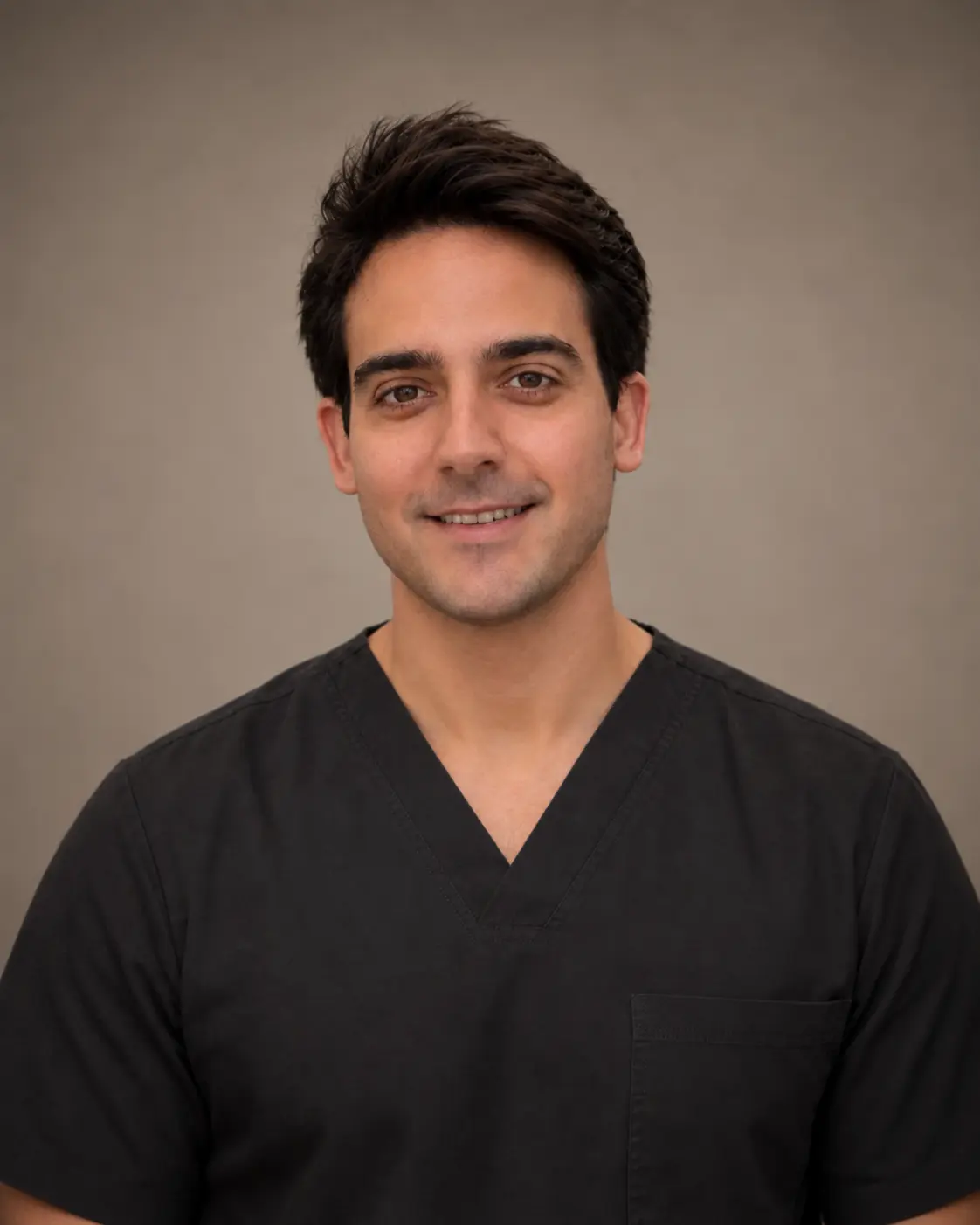
 Medical content reviewed by Dr. Román Ballesteros Redondo Dermatologist · Medical registration no. 462009018 · Last reviewed 8 August 2026
Alopecia areata is an autoimmune condition causing patchy hair loss, usually in round, smooth areas. It is not contagious or caused by poor hygiene and, unlike scarring alopecias, does not destroy follicles: hair can regrow. At the trichology unit of dermaMER Instituto Médico Dermatológico, in Valencia, we diagnose it, assess activity and suggest treatment appropriate to each severity level, also addressing emotional impact.
What it is and how it progresses
In alopecia areata, the immune system temporarily attacks the follicle base. It is non-scarring: openings remain and follicles retain the ability to produce hair, although regrowth is less likely with extensive, longstanding disease. See a dermatologist as soon as it is detected to establish treatment promptly.
It usually causes one or more smooth hairless patches, but may affect the beard, eyebrows, eyelashes or body hair, and extensive forms may cause alopecia totalis or universalis. The exact cause is unknown: there is genetic predisposition and other autoimmune conditions often coexist. Stress is not the cause, although it may act as a trigger.
Autoimmune attack
The immune system temporarily attacks the follicle base.
Smooth patches
Hair falls out in one or more round, smooth patches; the beard, eyebrows or eyelashes may be affected.
Preserved follicle
Non-scarring: openings remain and follicles retain the ability to produce hair.
Unpredictable course
A patch may regrow spontaneously, persist or enlarge; early treatment helps slow progression.
How we diagnose it
Diagnosis is usually clinical, supported by digital trichoscopy, showing characteristic signs — yellow and black dots, exclamation-mark hairs — with preserved openings. Baseline photographs document extent.
Other hair conditions look very similar, so dermatological assessment is important for accurate diagnosis and appropriate treatment. Blood tests are targeted and biopsy reserved for uncertain cases.
Treatment: options and limitations
The decision depends on extent, age, progression speed and emotional impact. Depending on the case:
- Anti-inflammatory treatment injected into the patch through mesotherapy, the first option for localised disease. This is performed in the clinic and may require several sessions.
- Oral targeted treatment for severe forms: options authorised in Spain provide a response in some patients and require specific safety monitoring.
What treatment cannot do
No treatment removes autoimmune predisposition: areata can be controlled but not cured, and regrowth does not prevent new patches. Complete regrowth cannot be predicted, nor can a test identify who will respond. Targeted treatment does not produce sufficient response in everyone and usually needs maintenance.
Time expectations must also be realistic: regrowth is assessed in months rather than weeks and may continue increasing afterwards. Delayed effects do not mean treatment is failing. If loss instead represents a scarring alopecia, destroyed follicles cannot recover.
When to seek advice and your first consultation at dermaMER
Seek advice for one or more sudden patches, especially with rapid progression, large areas affected, eyebrow or eyelash loss or significant emotional impact.
At the first visit, we review onset, previous episodes and impact on your life. We examine scalp, eyebrows, eyelashes and nails, suggest digital trichoscopy and document the baseline with photographs. We then propose a severity-based plan.
It is part of our hair medicine service in Valencia, available in Spanish, English and Italian. You can meet the medical team before your visit.
Frequently asked questions about alopecia areata
Can alopecia areata be cured?
It can be controlled, but no treatment removes autoimmune predisposition. Regrowth is common in recent, localised forms; relapse is also common.
Is it contagious?
No. It is an immune system condition, not an infection.
Will I lose all my hair?
Usually not: one or several patches are typical. Totalis and universalis forms are less common, with greater risk when loss is extensive, begins early or affects nails.
Why has white hair grown in the patch?
This is common. Regrowing hair may initially be fine or unpigmented and later regain thickness and colour: it does not mean treatment is not working.
What results can I expect?
This depends on extent and duration. Complete regrowth cannot be predicted, and assessment takes months.
Does stress cause it?
The exact cause is unknown, and attributing it solely to stress oversimplifies it: episodes may coincide with stress, but the condition is autoimmune with individual predisposition.
Can I use a wig, fibres or micropigmentation?
Yes. They do not alter the condition but help daily life while awaiting treatment response.
Does insurance cover an alopecia areata consultation?
Consultation and follow-up are usually covered, depending on insurer and policy type. Digital trichoscopy and mesotherapy are usually excluded and paid for separately. Check the insurers we work with.
Trichology consultation for alopecia areata in Valencia
dermaMER Instituto Médico Dermatológico
Calle Timoneda 4, Bajo, 46008 Valencia
Mon–Wed 9:00–14:00 and 15:00–19:00 · Thu 10:00–14:00 and 15:00–19:00 · Fri 9:00–14:00
☏ +34 960 20 71 71
View on Google Maps