
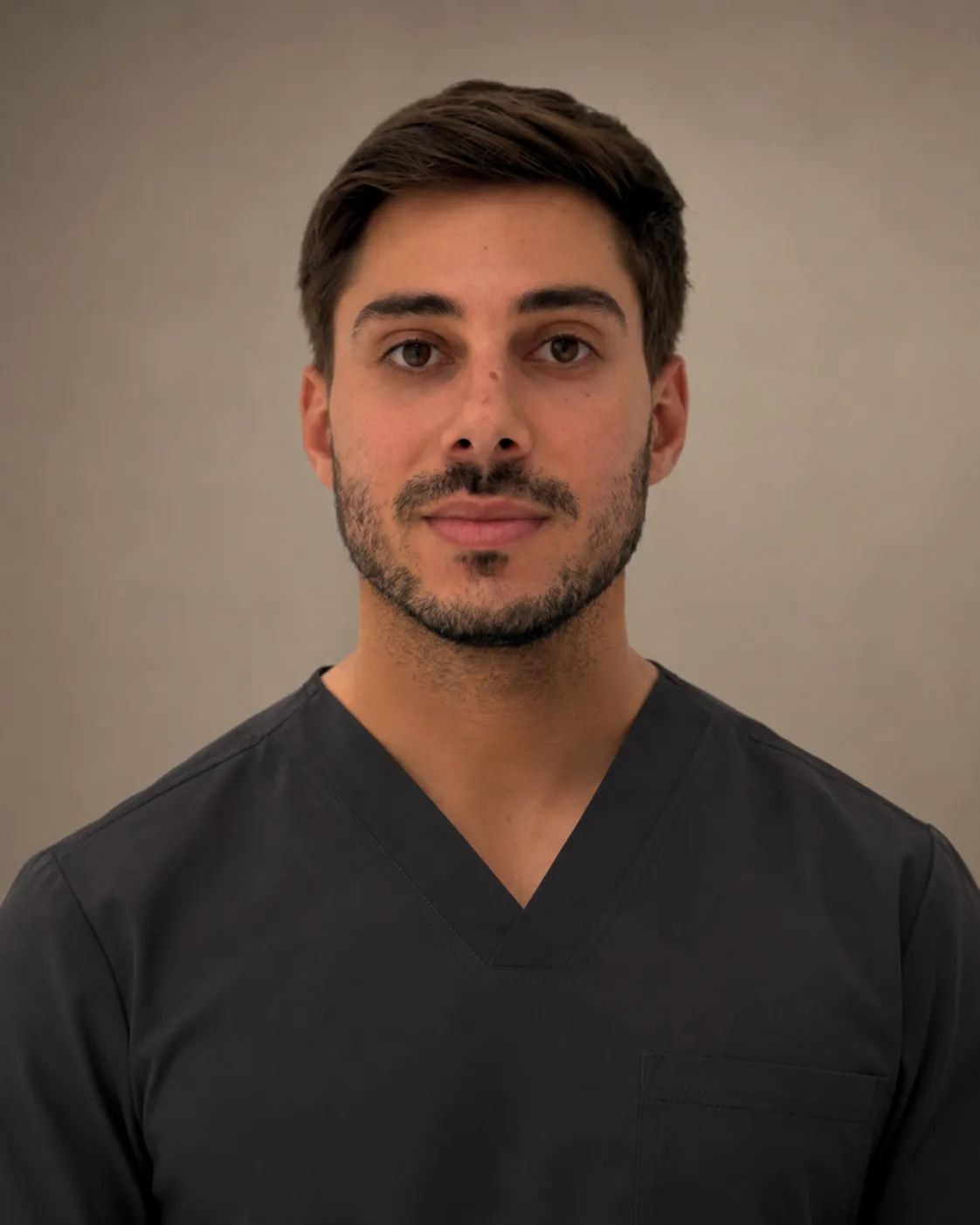
 Medical content reviewed by Dr. Enrico Giorgio Morales Tedone Dermatologist · Medical registration no. 461205707 · Last reviewed 8 August 2026
Melasma is a pigmentation disorder causing brown or greyish patches, usually symmetrical, on the cheeks, forehead, upper lip and chin. It is common, benign and tends to recur.
At dermaMER Instituto Médico Dermatológico, we assess and treat melasma and skin pigmentation in Valencia. The first step is always to confirm the type of pigmentation, as different types behave differently and need different treatments.
We then develop a phased treatment plan focused on lightening the pigment and, above all, preventing its return.
What is melasma and why does it develop?
Melasma develops when the cells that make skin pigment produce excess melanin in certain areas, forming broad patches with poorly defined edges.
How melasma forms, step by step
Balanced pigment
The cells that give skin its colour produce pigment in a balanced way.
Sunlight and hormones
Solar radiation, visible light and hormonal changes stimulate them.
Excess pigment
More pigment than needed is produced and accumulates.
Visible patches
Brown patches, often symmetrical, appear on the face.
There is no single cause. Genetic predisposition — relatives often have similar pigmentation — light exposure and hormonal factors all play a part.
Ultraviolet radiation and visible light activate pigment production and reactivate previously lightened patches; this is why melasma often darkens in spring and summer. Hormonal changes during pregnancy or certain hormonal treatments trigger or worsen it in some patients, although many people develop it without either factor. It also affects men, less frequently.
It is worth knowing that irritation worsens melasma: harsh cosmetics, excessive exfoliation or overly intensive procedures can darken patches because inflammation stimulates pigmentation.
Types of skin pigmentation
«Pigmentation» is not a diagnosis. Before treatment, it is advisable to identify the type, as each behaves differently.
Melasma
This forms broad, fairly symmetrical patches in the centre of the face, intensifies with sunlight and follows a prolonged course with improvements and relapses.
Sun spots
These are individual, well-demarcated spots with defined edges caused by accumulated sun damage. They mainly appear on the face, décolletage and backs of the hands, and respond better than melasma to certain pigmentation and rejuvenation treatments.
Pigmentation after inflammation
This develops where there was previously a spot, dermatitis, burn or procedure, following the shape of the previous lesion. It is very common in patients with acne, and usually fades gradually.
Pigmented lesions that need assessment
An isolated, asymmetrical lesion with several colours that grows or changes over time should not be treated before assessment. In these cases, our mole check with dermoscopyis indicated.
Diffuse melasma, a few sun spots and residual pigmentation from previous acne often coexist on one face. This is why the plan is built in layers, rather than as a single «pigmentation treatment».
Diagnosis and why melasma tends to return
Diagnosis is clinical, based on the appearance, distribution and history of the pigmentation.
During the consultation, we ask when it appeared, whether it coincided with pregnancy, a hormonal change or intense sun exposure, how it varies throughout the year, and which products you have used and with what results.
We use dermoscopy to guide assessment: a magnifying lens with light allows detailed examination of the skin without discomfort. In some cases, we use a special light to help estimate pigment depth. Not everyone needs the same tests: most melasma is diagnosed through examination.
Why is melasma difficult to treat and prone to returning?
Because it is more than a simple superficial accumulation of pigment. The cells that produce it remain particularly reactive and readily start producing it again, even after the patch has lightened.
As light is part of daily life, brief, repeated exposure can be enough to reactivate it. Deeper pigment also responds slowly and incompletely.
Pushing treatment harder does not speed up results: increasing intensity or frequency often causes irritation and, with it, more pigmentation. Consistency produces better results than an aggressive approach.
Melasma and pigmentation treatment in Valencia
There is no single treatment for every patient. The choice depends on the type of pigmentation, apparent pigment depth, skin tone, duration and personal circumstances — pregnancy, for example, limits some options.
Daily sun protection
This is the foundation of treatment and maintenance, rather than an add-on. A tinted broad-spectrum sunscreen is recommended because it also protects against visible light. Apply enough daily, alongside seeking shade and wearing a cap or hat.
Depigmenting treatments applied to the skin
These are products prescribed by your dermatologist to reduce pigment production. They are used in cycles, with reviews, and need supervision: continuing them independently can irritate the skin and worsen pigmentation.
Oral treatments in selected cases
For moderate or resistant melasma, oral treatment may be considered after reviewing your medical history. It is not an option for unsupervised use or suitable for everyone.
Dermatological procedures
Superficial medical peels may be used as an adjunct, never as a replacement for sun protection and treatment at home.
Laser and intense pulsed light, used cautiously
These are not the first choice for melasma and are reserved for selected cases because of the risk of worsening or more intense recurrence. They have a clearer role in treating sun spots.
Pacing matters: the first changes are usually noticeable after eight to twelve weeks of correctly applied treatment, and results are assessed over several months. After the initial phase, treatment moves to maintenance with better-tolerated products.
Realistic treatment results
A realistic result is a gradual reduction in the intensity and extent of pigmentation, rather than a promise of complete disappearance or a tone exactly matching the surrounding skin.
Melasma has no permanent cure: treatments lighten pigment and control the condition, but do not remove the tendency to produce it. Relapses after stopping treatment or after summer are common.
Results vary between patients. Stopping hormonal treatment does not necessarily make melasma disappear, and sun protection alone does not remove existing pigment, although without it, other treatments offer less benefit.
To assess improvement properly, we compare photographs taken in the same lighting and position: images with different lighting or make-up can be misleading.
When should you see a dermatologist for skin pigmentation?
A dermatological assessment is advisable when:
- a new pigmented lesion appears and grows or changes shape or colour;
- a lesion is asymmetrical, has several shades or stands out from the others;
- facial pigmentation darkens every summer;
- the products you have used fail to improve pigmentation or worsen it;
- your skin becomes irritated, stings or reddens with depigmenting treatments;
- pigmentation appeared during pregnancy or after a hormonal change;
- pigmentation remains after an acne or dermatitis flare-up;
- pigmentation affects your wellbeing or daily life.
Your first melasma consultation at dermaMER
At your first visit, we confirm the diagnosis and rule out other types of pigmented lesions. We assess your skin tone, apparent pigment depth and extent of pigmentation.
We also review your hormonal history, usual sun exposure, cosmetics and previous treatments, as many cases involve several contributing factors.
We use this information to agree a phased plan: sun protection, initial depigmenting treatment, review of tolerance and response and, only if still indicated, additional procedures followed by maintenance. From the outset, we explain what results are reasonable to expect and within what timeframe.
At dermaMER, we treat skin pigmentation at our dermatology clinic in Valencia as part of our medical dermatologycare. You can meet our dermatologists before your visit.
Frequently asked questions about melasma and pigmentation
Can melasma disappear completely?
It may lighten considerably and remain controlled, but complete disappearance or freedom from recurrence cannot be promised. This is why the plan always includes maintenance.
Why have I developed pigmentation during pregnancy?
Hormonal changes during pregnancy are a common trigger. Pigmentation sometimes improves after birth; during pregnancy, sun protection is the main measure and depigmenting treatments are postponed.
Is sun protection really that important?
Yes. It is the foundation of treatment. Without daily sun protection, including in winter and on cloudy days, other treatments offer less benefit.
Will any depigmenting cream work?
No. An unsuitable product can irritate the skin and darken pigmentation. Depigmenting treatments should be prescribed and reviewed by a dermatologist.
Does laser remove pigmentation?
It depends on the type. Laser has a clearer role in sun spots; for melasma, it is not the first option and may worsen it if used inappropriately.
How long before improvement is noticeable?
The first changes are usually noticeable after eight to twelve weeks, and results are assessed over several months. Increasing intensity does not speed up the process.
Can it return after lightening?
Yes. Relapse is common, particularly after summer or when maintenance is stopped. Restarting treatment early usually makes control easier.
Does my insurance cover melasma treatment?
Consultation and diagnosis are usually covered by health insurance policies, depending on the insurer and policy type. Depigmenting treatments, peels and laser are considered cosmetic under most policies and are generally paid for separately. Check the insurers we work with.
Dermatology consultation for melasma and pigmentation in Valencia
dermaMER Instituto Médico Dermatológico
Calle Timoneda 4, Bajo, 46008 Valencia
Mon–Wed 9:00–14:00 and 15:00–19:00 · Thu 10:00–14:00 and 15:00–19:00 · Fri 9:00–14:00
☏ +34 960 20 71 71
View on Google Maps